Thursday, April 24, 2014

IF AT FIRST YOU DON'T SUCCEED, TRY, TRY AGAIN

We don't know how resilient our children are, until we give them an opportunity to show us. Yesterday C had a dentist appointment. Two weeks ago he watched a cartoon that showed the main character visiting the dentist and losing a tooth. The Tooth Fairy visited the character (I can't remember which cartoon it was, but I think it was on Disney Jr.), and from that day on, C asked daily to visit the Dentist and have the Tooth Fairy visit. Of course he asked in his own way, "We have to go to the Dentist today, I have a loose tooth and the Tooth Fairy needs to come."

Many of us have anxiety visiting the dentist, and because of our anxiety, I think we tend to pass the fear on to our children. Add in a cognitive, developmental, sensory or attention issue, and there is a potential for disaster. When I made the appointment, I made sure that the team at the office had updated their files to show C has Autism. I didn't realize that I was nervous, until C got into the chair. C however, had no anxiety. He climbed right into the chair, looked the Dentist in the eye, and smiled.
C with Dr. Katz

Our visit was perfect. C was uncomfortable with the buzzing contraption they use to clean teeth, squirming, but not complaining. He didn't bite, didn't yell out, and remained in the chair. He had no cavities, no loose teeth, and his oral hygiene is top notch, according to the Dentist.

After the clean bill of health, the Dentist, Dr. Katz, looked me in the eye, and said, "C did amazing!". My eyes welled with tears, and I let go of the breath, I didn't even know I was holding. Trained at Kennedy Krieger, Dr. Katz has a complete understanding and acceptance of our children's needs. He was patient, accommodating, and was able to work quickly and efficiently.

Having a dentist that is calm, while working on our children, and in addition, understands our children's needs, on a level greater than the average, proved to be a key component to our successful visit. Putting my mama fear to the side, and acting as if a visit to the dentist was as common as a day in the park,  ensured C had no anxiety.

I know that I sometimes cancel plans, don't attend functions or parties, and plan our family activities around C's past successes. What I tend to forget is that I will not know how C will react to a situation, unless I put him in that situation. C's success is based on the experience I allow him to have. If we keep him contained in the safe bubble of our home, how will he ever learn to navigate the world around him successfully? My fear cannot hold him back. My sensitivity to others response to his Autism, is my own issue, not his. What I forget is that the community around us is learning, becoming aware, more accepting of his needs and response to his environment. If I encounter someone less understanding, it is my responsibility to try to educate and encourage acceptance.

There will be failures, I will attempt activities that just won't work with his needs, but I have to try. And if I encourage C to try, and try again, maybe he will learn to tolerate activities that we never thought possible. If we, as a family, surround C with guidance and support, and contain our own aversion and fear, if we try, maybe those activities we thought were going to be failed attempts will be successful and natural, just as a trip to the dentist turned out to be.


For more information about Dr. Katz practice: Katz For Kids

Monday, April 14, 2014

Enough of the Sleepless Nights, Already

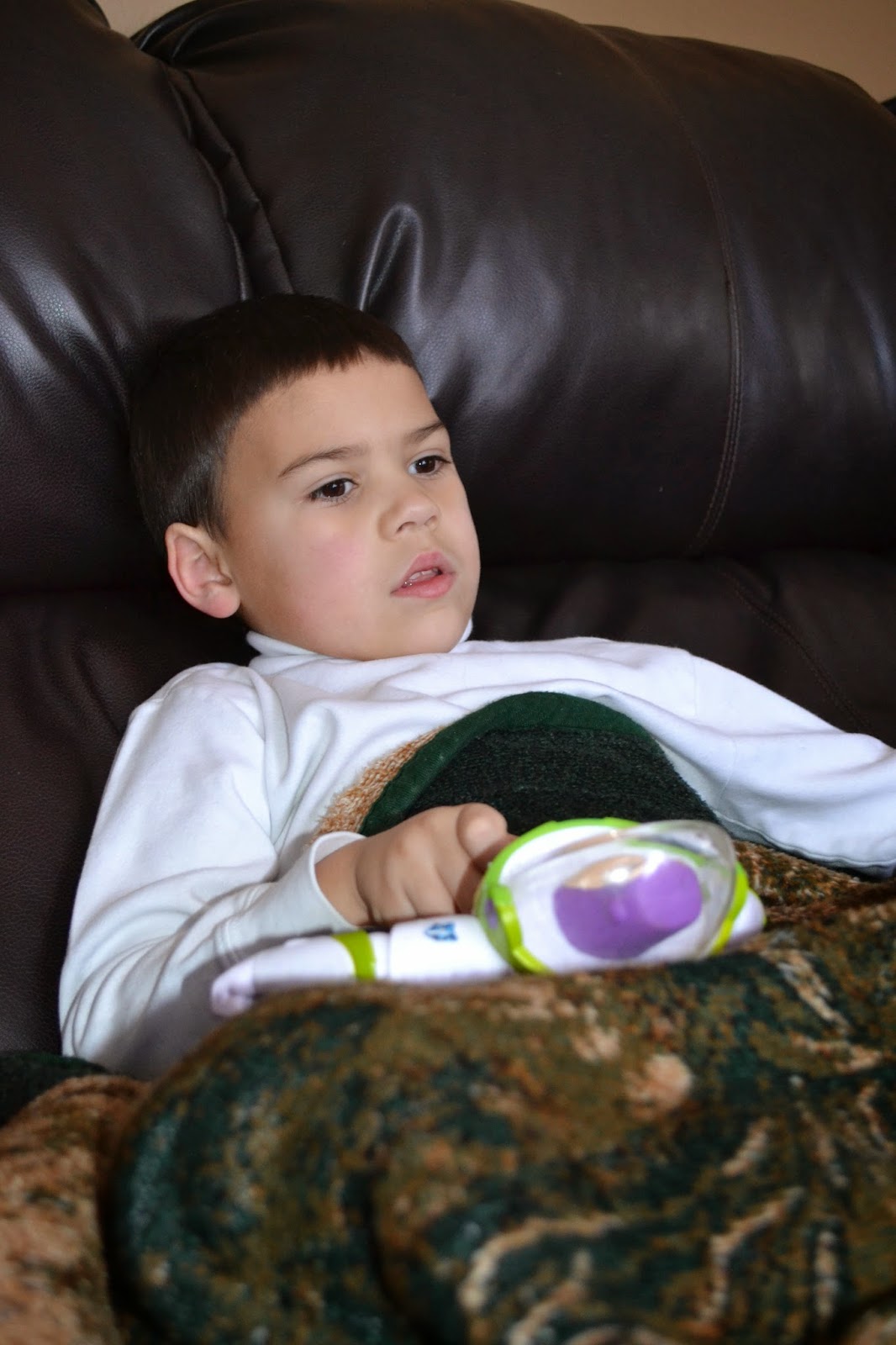
C sitting on the couch after another restless night

Autism, Apnea, or Meds... Oh my


C had a doctor's appointment Friday. He has never slept well. We spend our nights waking in the middle of the night, questioning whether we should try to coerce him back to sleep, or let him figure it out on his own. Then we spend the rest of the night angry at ourselves for the decision we made.
Engaging C, in the middle of the night makes him think that it is indeed morning time. Time to gather his "friends" head downstairs, watch a cartoon, and eat breakfast. Going back to bed is simply not an option.
To leave him alone, means spending the evening with one eye open, one ear diligently waiting for his voice to come barreling down the stairs, or worse even, the dreaded silence.

I know that many children with Autism have difficulty differentiating between night and day. I have heard stories of children waking up in the middle of the night, just like C, and feel as though because they are awake, it must mean the start to a new day. I have heard that sometimes seizure activity can cause sleeplessness, sleep apnea could be another cause, lower melatonin levels... There are an abundance of reasons, but what do you do when your child doesn't have the means to explain to you why they are so restless?

So we are on the hunt for a full night's sleep. A was not a good sleeper, and had terrible asthma. We spent his first 4 years of life waking in the middle of the night to administer albuterol  treatments. Then we had O, who didn't sleep through the night until he was three, but in the meantime, we had C when O turned 2... leaving us sleepless for the last 11 years. We are exhausted, we survive on caffeine, and we are ready to turn this corner in our life.

When you have a child with special needs, it seems as though your days become consumed with research, hypotheses, and in turn, the commitment to prove the theory. In our case, the theory becomes harder to prove, as we are searching through an abundance of information, seemingly because everyone is looking for answers to the rise in Autism, leaving many contradicting research options, and we have a child who has words, but rarely gives us insight into his sweet little brain. We have to rely on our past theory failures to guide us toward our new theories.

When we first received the diagnosis, it seemed that every day we had an appointment with this specialist or that. We learned a lot about Autism in general, but had very few immediate and insightful findings specific to C. Our greatest accomplishment in all of the pricks, prods, and heartbreaking exams, assessments and tests, was finding that C has a wheat and egg intolerance. We, in a way, lost hope in finding answers and decided to focus on bettering C's life, short and long term.

Now we need answers. We are revisiting all of the specialists, re-administering many of the tests, and praying that rather than getting the generic and not useful answer of "it is because of his Autism..." we receive, here is the problem, and here is a potential solution.

We have felt that medication, unless C is unable to function without it, and unless we have exhausted all other options, is not something we want to pursue. Even though it has been 2 1/2 years since the diagnosis, we feel we are still new to... well everything. C is making incredible progress. He has made friends in school, has gone from one word demands, to 2 and 3 sentence phrases, that are relevant to what is going on around him. He is academically on par with his peers (though his fine and gross motor skills are still about a year behind), and he is happy. Medication, right now, seems to be something we should continue to push to the side... BUT, then there is the matter of sleepless nights, leading us to restless days, and then a greater potential for meltdowns, obstinate behavior, and further difficulty leading him back on track.

SO... back to the doctor's we go, starting with another visit to the ENT. We are going to check his adenoids to ensure that they are not enlarged, leading to sleep apnea. We are going to have his hearing checked again (purely out of my curiosity... We had it tested before, but because he was non-verbal it was rather difficult to get an accurate reading), we are going to research his lack of smell (the child has never indicated a foul or good scent, weird right?), and we are going to see if his sinuses are enlarged.

If we have no answers that make sense for his restless nights from the ENT, then we will move on to a Behavioral Pediatrician. This is where we may receive the "it is because of his Autism" answer. The pediatrician alluded to his slew of vocabulary, relevant or irrelevant, and his need to vocalize it. If he is unable to stop his brain from telling his voice to speak during the day, perhaps his brain is in overdrive at night as well. Perhaps he needs a means to help his brain settle so that he can rest peacefully at night.

We are hoping for answers from the ENT. For once, we would like a cut and dry answer and "fix". In the meantime, if you happen to be up between 2 and 3am, think of us, as we are up as well.

Tuesday, April 8, 2014

Let's Stop Using Fear as a Means of Awareness

To envision a world without Autism, is to envision a world without my son. I posted this article on my personal Facebook wall yesterday, and it drummed up a bit of discussion on eugenics, and Autism Speaks, and even a bit of politics. Obviously I posted the article on my personal wall, because I felt that my opinion is mine, not reflective of our Foundation as a whole, however I feel that there is merit to discussing it in a larger forum.


I also want to mention that I personally feel that using fear as a tactic to solicit support, funds, and/ or followers is the wrong tactic to use. Are the number of children being diagnosed with Autism increasing - yes. This isn't a reason to scare society into action. The numbers speak for themselves. We have to take action, and support families who care for those with Autism, we need to support families faced with any diagnosis. It can be lonely, and to use fear as a method of soliciting support leaves many feeling as though they need fixing. It feels dirty. Let's provide education behind the numbers. Let's truly make a case for what having Autism means, and let's be real about what it means for future generations. Let fear be an emotion that one chooses on their own, without being provoked into the emotion. I was scared of Autism, at first. I am not scared anymore. I choose to feel hope, I choose to look towards obtainable goals that will help my child succeed. There are moments of fear, but it is fear of the unknown... not of the diagnosis.

I truly believe Autism Speaks has desire to help families impacted by Autism. As stated on their website, they are "dedicated to funding research into the causes, prevention, treatments and a cure for autism; increasing awareness of autism spectrum disorders; and advocating for the needs of individuals with autism and their families." Their first priority is to research causes, prevention, treatments and a cure, and their secondary goal, and I assume, as a supplement to their first priority, is to increase awareness and advocate. While I want the future, and unborn generations to have an answer to what causes Autism, how to educate expectant parents on the causes and preventative measures to take for their unborn fetus, I can't help but to feel that there is a greater mission that is missing. Whether a part of Autism Speaks fundamental mission statement or not, there is more work to be done. By not addressing this missing link, I think that it leaves those affected currently by Autism feeling skeptical.

Currently 1 in 68 are diagnosed with Autism. As I stated before, the numbers are derived from statistics of children born prior to 2003.  Of those children, how are we, as a Country, going to help the caregivers and children prepare for their future? How are we, as a Country, going to prepare our greater population, for adults that are going to need additional help, accommodations, acceptance, awareness and support? I think what is missing from the Autism Speaks mission, that so many, including those with Autism want addressed, is help that is needed for those with Autism, now.

I don't want to cure my son, I want to help my son fit into a world that is circular, when his genetic make-up is square. I want for therapies and treatments to be accessible to our family, without fear of having to put a second mortgage on our home to pay for them. I want the world to understand my son, and accept him. You don't have to like him, you don't have to understand him, and you certainly don't have to pity him, just accept him for who he is, as you would require those around you to grant you the same respect.

I think that unfortunately, in raising awareness, and fighting for our loved one's, we choose words, and target individuals or organizations, that are controversial. We choose to use fear as our tactic. We say, let's cure these individuals, let's prevent this from happening to future generations, and it leaves those affected feeling as if they are second class. As if they are in a world where they don't truly belong, and are simply made to feel as something that everyone should be aware of, and not necessarily accepted.

I choose to believe that Autism Speaks is here to provide valuable resources to parents who are just diagnosed. They have wonderful toolkits, available for free, for any family member trying to understand Autism. I believe that they are here, to provide funds to researchers, in hopes of finding out why these numbers continue to increase exponentially, and how we can prevent further rise. 

I believe that is up to us - caregivers, family members, self-advocates, friends - to ensure that those who are living with Autism today, get the care, respect and inclusiveness they deserve, just as any other member of the human race deserves. We need to ensure that we promote acceptance and awareness, educate our community on the difference, and promote inclusive environments. We don't need to "Light it up Blue" to do that. We need to get out, we need to share our story. We need to promote self-advocacy, and most importantly, we need to listen. We need to ensure that our loved one's with Autism not only have a voice, but that their voice matters. 

I love that we live in a Country that supports our freedom of speech, that we are able to choose our beliefs. It is a right and a privilege. Let's ensure that we extend those same rights to those with disabilities.

 "Just because I can't speak, doesn't mean I have nothing to say."

Friday, April 4, 2014

Have a Stimmer?

Self Stimulating Behaviors

What are they, what can I do? 

C is sensory seeking. He loves running his fingers through my hair, the dog's hair, and twirling his own hair is a tell tail sign that he is tired. While no one has directly told us that C has SPD (Sensory Processing Disorder), I think at this point, it is a fair assumption to believe that he does.

Some common characteristics of a child exhibiting SPD:

People suffering from over-responsivity might:
  • Dislike textures in fabrics, foods, grooming products or other materials found in daily living, to which most people would not react. This dislike interferes with normal function, for instance a child who refuses to wear socks or an adult who is so "picky" they can't go to restaurants with friends.
  • Get so car sick they refuse to be in a moving vehicle.
  • Refuse to kiss or hug, not because they don't like the person, but because the sensation of skin contact can be very negative.
  • Feel seriously discomforted, sick or threatened by normal sounds, lights, movements, smells, tastes, or even inner sensations such as heartbeat.
People suffering from under-responsivity might:
  • Fidget excessively
  • Seek or make loud, disturbing noises
  • Suck on or bite clothing, fingers, pencils, etc.
**From Wikipedia


C exhibits mostly over - responsivity symptoms. He frequently will wrap himself around my leg, throw the covers over top of himself, and roll up like a sausage, and is known to squeal when he is happy or excited. 

What we have learned, through Occupational Therapy and Sensory Integration Therapy, is that children will use sensory seeking behaviors to help them better understand their surroundings and how their body fits within those surroundings. It is self soothing, and incorporates one of the fives senses. 
  • Visual  staring at lights, repetitive blinking, moving fingers in front of the eyes, hand-flapping
  • Auditory  tapping ears, snapping fingers, making vocal sounds
  • Tactile  rubbing the skin with one's hands or with another object, scratching
  • Vestibular  rocking front to back, rocking side-to-side
  • Taste  placing body parts or objects in one's mouth, licking objects
  • Smell  smelling objects, sniffing people
 **From the Autism Research Institute

Take, for example, a child who rocks back and forth. Though the behavior is a-typical, it is giving them feedback, allowing them to realize how their body fits within a certain setting. This is considered a "self-stimulating" behavior, or stimming. While it is providing self soothing benefits, research shows that stimming also decreases one's attention to task, correlating with the ability to learn new information. Many professionals in the field advise parents to monitor stimming behaviors and limit them, by giving new behaviors or coping mechanisms to enable the child to attend to a task, and feel comfortable in their environment. 

C has a variety of stims, from tapping his foot, to flapping his hand, he squeals loudly, and will rub his hands over his pants repeatedly. We have tested quite a few strategies to help him cope, specifically in school, but also in the home. We can tell what strategy we need to use, based on the stim. 


For instance, C will run his fingers through my hair. While most times I enjoy it, it also handicaps me from doing anything else. We know that his seeking textile feedback, and have made a rice bin filled with scoops and bowls for him to play with instead. This serves two purposes, it allows me to be a little more free, and allows C to practice fine motor skills, while getting the feedback he is craving. 

C will also, as I stated above, wrap his legs around me, or swaddle himself in blankets. We have a weighted blanket, which provides the pressure (evenly) that he is craving. In school, they have taken this strategy, and have replaced it with a weighted vest, which allows C to walk freely, while still getting the feedback he needs. We have noticed, that when used in school, it helps him attend better to tasks or activities.

We are still working on strategies to use for the squealing. He is high pitched an LOUD! I have heard that chewing gum helps, but I have been hesitant to give it to him, for fear that he may choke. 

We noticed that prior to our understanding of SPD, C was unbalanced, had a toddler gait, could not jump, and did not run with a straight gait. After 2 years of therapies, he is like a new child. He fine motor skills have improved, he is able to jump, and his language even blossomed. 

Many consider OT, or SI (Sensory Integration) for children who lack coordination or fine motor skills, however there are a great many other benefits. We tend to overlook a lot of behaviors that accompany our children, simply because it may be a symptom of the diagnosis. There are strategies to help our children overcome many of the self-stimulating behaviors. While I personally feel that there is a time and place where stimming is appropriate, I also understand that like everything else, it must be done in a structured and strategic manner. 

For more information on Sensory Integration:
Sensory Integration Therapy


Wednesday, April 2, 2014

Carly's Voice - A True Advocate for Autism Awareness

A must read for those trying to better understand Autism

In just 3 days I read Carly's Voice, Breaking Through Autism. I had prepared this wonderful piece introducing you to Sensory Integration, and C's experience with SI and OT, but after reading this book, I have to reconsider what I wrote.

Written primarily by Arthur Fleishmann, this book honestly and clearly paints the picture of a family raising a child with an Autism Spectrum Disorder. I laughed, I cried, I celebrated, and I marveled at this family's perseverance, but most importantly, I marveled at Carly's perseverance, at her will to want more, and her ability to use her voice, even when her traditional  voice failed her.

As I read, I found myself replacing Arthur and Tammy's anecdotes of daily life, of internal struggle, guilt, and happiness with our own stories of daily life. C rarely sleeps through the night. There was a period of time where we woke with him several times in the darkness of night, cleaning the havoc he created in his bedroom. He would tear his bed apart, throw all of the clothes out of the dresser, all of the toys out of the toy box and squeal so loudly, there was no choice but to wake. He was a midnight terror. We hadn't slept in years and we began to resent it, resent the witching hour, resent each other for not getting up first. After a consult with a Behavioral Psychologist, we stripped his room of just about everything personal. I joke that it looks more like a closet than a bedroom. It works. " 'Carly, get back in bed', I told her, a bit roughly. Although she complied, I knew this was the beginning of the day, not the end of a momentary disruption of the night." Arthur Fleishmann

Though Carly is non-verbal, her Autism symptoms so greatly resemble much of C's behavior (just a bit more extreme), I have found myself questioning everything I have read, everything I was told by doctors. Verbal Stim, or "Audio Filtering" as Carly describes it. Stimming behavior or OCD? Self Injurious behavior or a tactic to stop one's self from a worse behavior?

I have spent the last year chastising myself for not allowing C to be more independent, challenge him more in the area of self-help, push his educational limitations. It is frustrating, for him, for me, for our family. I find my patience wearing thin, never with C, but my poor, older boys definitely bear the brunt of my depleted patience. Is C being stubborn, is Autism creating a barrier, should I push, is it too much, how much is really too much?

After reading this book, specifically the last chapter, where Carly has the ability to really tell what Autism feels like to her, how aware she really is, her ability to persuade, all from her perspective, I feel like I have been given the key to the chest of hope. I know that C is intelligent, more so than many of us give him credit for. Does he play me for a fool, like Carly, is he able to manipulate ? Manipulation requires a multitude of high executive functioning abilities. I think I am not giving him credit for the little man that he really is. When he refuses to comply with a request, is he really just being defiant? Is Autism blocking his ability to filter the request into meaningful (to him) words?

Very often my husband and I say "if we could just help his brain figure out how to get from point A to point B, without interference, on the path of least resistance, maybe it would all just... click. " 'I feel like there's a button in her brain we just need to switch on,' Tammy said. But that button would remain out of sight, out of reach...it was time to stop asking why, and start asking now what?" And how often do I remind myself that the "why" won't help solve the immediate need of "now". That in order to understand the greater picture, I have to focus on what works now, and how that can help us in the future.

This book has resonated with me. I found myself dreaming of conversations I would have with Carly, if given the opportunity. I want to know how to best help my child, but I want to know from his perspective. I can see the questioning look in his eyes, when he tries to tell us something that we simply cannot comprehend, and rather than disassemble the pieces of the puzzle, mostly in an effort to be efficient, we just smile and nod. How frustrating for him to know that we just don't get it, and be unable to figure out how to speak to us, in our world, when he comprehends on a greater platform what is happening in his world. How frustrating for us, to want to help, and feel so hopeless in the endeavor.

It breaks my heart that Carly expresses the need to fit in, the want to "behave normally", and being in a body that just won't cooperate with those desires. The inability to be able to communicate in a traditional way gave the appearance that she cognitively was incapable of taking in and processing information in a useful way. Despite the doctor and psychologists low expectations, Tammy and Arthur fought, for every opportunity, every hope, every dream that they had for their daughter, and look at her now. A true self - advocate, speaking for those who have been unable to release their "inner voice".

On the day when we are to "Light it up Blue", to show our support and raise awareness for Autism, I find myself taking my own introspective look at how I advocate for my son's needs, how I educate those around me, and how I do my part in raising awareness. I have a new hero, and her name is Carly Fleishmann. I have a new perspective on life with Autism, and I have a new resolve to ensure that I show my deep respect for C's abilities and achievements, that I continue to embrace his independence and that I take each day in stride. I know how hard he is trying, just by the strides he has made over the last year. I, like Tammy and Arthur will continue to fight for what C needs, and I will ensure that his "inner voice" is heard.


For more exerpts from Carly's Voice:
Carly's Voice, Breaking Through Autism

For more information on Carly visit her You Tube Page:
Carly Fleishmann's You Tube Channel

Like Carly on Facebook:
Carly's Facebook Page

Monday, March 31, 2014

Disney Experience, Part II

 Top Ten Preparation Tips


It has been two months since our visit to Disney, and I feel like it was just yesterday. We went hopeful and yet skeptical. We didn't know how C would take to the crowds, the scents, the sights, the larger than life characters, he so lovingly adores. We knew that there would be moments of sensory overload. We knew that there would be challenges, what we didn't foresee was his ability to overcome those moments.

Our trip was a balancing act. It required planning, preparation, teamwork, and sometimes a zone defense to ensure that we met C's needs, while also ensuring everyone was able to enjoy the vacation. With 3 children, pre-teen to special needs, I am proud to say we accomplished everything that was on their "must do/must see" lists.

If I were to break down our trip into the top ten things you must do in preparation for a trip to Disney, specifically if travelling with a child who has special needs, it would look like this:


1. Reserve a hotel, rental home, condo, or suite that will fit your child's needs best.

We have stayed on Disney property, rented homes and condo's and have tried to make it work in a hotel suite. Our best bang for our buck, while also best suiting C's needs was renting a home just outside of the Disney property. While we had to drive to the parks everyday, and pay parking fees, we also had more room to spread out, were able to bring items from home to make the space more familiar, and the icing on the cake... a private pool and arcade room. We rented the home with with my husband's twin and his family. The cost for a week in the rental home was less than we would have paid in a hotel, with many more amenities. Another bonus... a full sized washer and dryer ;)

2. Stick to a schedule.

If your child wakes early, eats breakfast, watches a cartoon, has lunch at noon, a snack at 2pm, dinner followed by bath and a bed time story - stick with it. Your child is going to be filled with so many "new" experiences, even if it isn't your first trip to Disney. Rather than force a new routine along with new experiences, new people, a new environment, maintain the normalcy of their routine. The parks allow you bring in food and drink, take advantage of this! We always bring a cooler stocked with sandwiches, chips, fruit, water bottles, candy. It will help keep you on schedule, even while waiting in line.

3. About the lines - Use the DAS, plan ahead, and for God sake, don't promise to take your child on a ride without speaking to the ride attendant first.

The DAS (Disability Access Service card), allows for those with disability to use the fast pass lane, without holding a fast pass. Plan out the rides and attractions that are a "must do/must see" before entering the park. You will want to have this ready to fully take advantage of the DAS and fast pass. They key to success is to visit Guest Relations as soon as you enter the park. There they will be able to tell you ride times, fast pass availability, where you may need to use the DAS, where a fast pass will work better, or where you may not need anything. They will also help you plan how to best accomplish your "must do/ must see" list.

If you are using a DAS for a particular ride, my greatest piece of advice is to send one adult to that attraction. Explain you have a child with a disability, and they will either issue the DAS card for that ride, or indicate that the ride can accommodate your child now. If you are issued a DAS card, take the down time to see a nearby parade, visit a character, or ride a ride with a short wait time.

We survived lines, wait times and the DAS Card by keeping C out of the loop. We knew what attractions and rides were important to him, but never made a promise or indicated that we would see something "now".

4. Stroller as a wheelchair - If your child can still fit in a stroller, DO IT :)

C is 5 and weighs nearly 50 lbs. For a typical child, he may be too big for a stroller, however for a child with special needs, it is essential. We have even considered purchasing a stroller that accommodates a larger child. When vising Guest relations (upon arrival to each park you visit), explain that your child has a disability and that you would like the "stroller as a wheelchair" pass. It is that simple. They will strap a red sticker to your stroller that has a picture of a wheelchair on it. The stroller provides a safety net, it allows easy maneuverability in crowded situations, and  when used as a wheelchair, allows you to take it right to the attraction.

Disney has an amazing imagination. Every ride, every attraction, is designed to target each of the five senses. For most, it makes waiting in line more tolerable, for kids with Sensory Processing Disorder, it is overwhelming, and can have the opposite affect that was intended. With the stroller, C was able to maintain his personal space, throw the sun visor over top of him, keeping sensory overload at bay. For the rides that are not wheelchair accessible, you are able to completely bypass the line.

5. If you are driving, consider a Handicap Pass for your car.

I had mixed feelings initially, when my husband and I discussed this. I felt that perhaps we were taking advantage of a situation. I discussed it with our pediatrician, who must sign the paperwork for the pass to be issued, and he felt that it was in our child's best interest, and for the safety of our child and family that we receive the Handicap Pass. Now that we have it, I don't know how I survived without it. Have you ever walked through a crowded parking lot, maybe with groceries in hand, other children meandering behind you, while struggling to maintain hand contact with your special needs child. Then suddenly your child drops to the ground, splays out, and becomes dead weight? It happens regularly to me. Knowing that I can secure a parking spot closer to our destination gives me piece of mind, that I can safely walk from point A to point B.

Disney's Handicap spaces are almost directly in front of the park's entrance. If you need a quick getaway, the last thing you want is to have to hop on the tram and pray that you remember the charcter's name of the spot where you parked.

6. I mentioned it before, but it warrants mentioning again - bring food with you into the park.

Picture the mid day heat, a morning full of parades and rides, a DAS card for a ride that isn't good for another 1/2 an hour, and you have a handful of crankiness staring at you. You would run over to the nearest food vendor, but everyone else seems to be having a serious case of the"2:30 feeling". And then you remember, your cooler full of your child's favorite snacks and drinks sitting in the bottom of your stroller... Crisis averted!

Let's face it, one can only take so much of fried, greasy, amusement park food. At some point your body begins to crave nutrients, and you don't want to spend buku bucks on the good stuff, snack money should be reserved for the special treats. This is also where having a refrigerator in your temporary home is essential.

7. Don't overdo it.

If you are planning a 7 day vacation, don't expect your child to be able to survive 7 straight days of parks. Goodness, I would be surprised if you could survive 7 straight days of parks! We have found, in our 5 trips to Disney in the last 7 years, that 4 days of Parks is just enough. We feel that the Magic Kingdom and Hollywood Studios are our "must do" parks. Sometimes we visit Animal Kingdom (the safari ride and the Lion King show alone are enough to make you go at least once). If you have a child that loves animals, is inquisitive, and has a passion for fact finding, Animal Kingdom is great! It reminds me of an interactive zoo, with rides and attractions to keep everyone happy. Epcot is fabulous for those that enjoy different cultures, cuisines, and there are a few awesome rides, including Soaring and Mission Space. We almost always visit the Magic Kingdom a second day, but if you have never been to Disney World before, consider visiting all of the parks. We purchased Park Hoppers only once, and it was when we stayed on Disney Property. Because we had free transportation between parks, it was nice, but not necessary. If you are trying to remain frugal, don't do it ;)

We try to put a day between each day of parks. It allows us to rest our bodies, enjoy our vacation as a family, and visit other area attractions. Downtown Disney is fun, and has no entrance fee. Again, don't overdue it!

8. Download the "My Disney Experience App".

This app has maps of all the parks, allows you to map out your day, manage meal reservations, and sets reminders for upcoming parades and attractions. We used it everyday, multiple times a day, from initial vacation planning through our last day of vacation.

9. Take advantage of Photo Pass.

The photographers are strategically placed for the perfect photo opp, and they will also snap a photo with your camera or phone.  The photographer will issue you a card that you can carry around with you for the duration of your trip. When you see a photographer in a location you would like to have your photo taken, simply hand them the card, and it will upload to the website. You will need to create an account to access your photos and of course there is a fee, but you have the ability to select and choose the pictures you want, and of course, there is no obligation to buy.

10. Remember to have fun.

It is not often that our family is able to truly disconnect from the fast paced world and enjoy time together. It was a conscience decision to put work aside and really connect, really take part in this vacation with our children. Making the decision to be a part of the fun, to embrace each moment, and live in the now, is what made this trip so memorable. We each have our own and separate "favorite" moments. We each accomplished everything on our "must do/must see" list, and we certainly made "magical" memories.

This trip is possible, and fun, with children and adults with all abilities. Disney has, in our opinion, lived up to their promise of offering inclusive fun for all. Plan ahead, be prepared, and go with the flow. If you don't allow for the opportunity, the opportunity may just pass you by.


Saturday, March 29, 2014

What Does 1 in 68 Really Mean?

Educate, Include, Empower, Embrace


I sat down to write Part Two of our Disney Adventure, and found my fingers itching to write about the CDC's new report highlighting another rise in the number of children diagnosed with an Autism Spectrum Disorder. While Disney is always a fun topic, I think that it is going to have to take a backseat today.

Yesterday the CDC released a report indicating that 1 in 68 children are diagnosed with an Autism Spectrum Disorder. If you click the above link, I think you will be pleasantly surprised that their report offers hope, calls for more information, more awareness, more education, a plea for early diagnosis. It does not slap the epidemic stamp on our children, it does not induce fear, and iterates the need for clinicians to use developmental screening tools to monitor a child's development and to take note of deficiencies, to educate parents on early intervention tools available.

It is also important to understand that this report is based off of children 8 years of age, and from 11 ADDM sites. In addition, the results are based on data collected in 2010, meaning that the children in the study were 8 at the time the data was collected.

I feel that it is important to take from these numbers that children with Autism, adults with Autism, are all a part of our community. You know someone with Autism. You know a family affected by this diagnosis. It should now be considered a part of our society's norm. While I understand the need and the want to know the cause, we need to embrace the community it affects. We need to ensure that our community at large is educated, understands the need of the individual with Autism, and offer community support, inclusion, and opportunities, equal to those of their typical peers.

When C was first diagnosed I found myself scouring the web, searching for a cause, secretly hoping that I was not to blame. I prayed that I didn't "give" this to my son. My grief turned to guilt. I wasn't alone, my husband felt guilty too. We simultaneously reassured one another that we were not to blame, while searching for hidden truths to the suspicion about ourselves. We started down a dark path, until one day we realized obsessing over the "why" wasn't going to help C. We redirected our efforts. We began looking at interventions, therapies, tools and accommodations to help C thrive. We educated ourselves and our family. We are continuously learning when to take a risk and push C's comfort threshold, and when to simply let him be... him.

C  having Autism isn't scary, it isn't the end of the world, it simply is. We hear that we should strive for our children to be like their "typical" peers, but what does that really mean? Who defines typical. We need to help our children survive in their environment. We need to help our children cope with the enormity that the world is. We need to give strategies to them, to ensure that they are reaching their full potential, and pushing them to be more than that. While a "cure" sounds fantastic in theory, what are we curing?

1 in 68 is alarming. What does 1 in 68 mean? It is no longer a "Disorder" that is rare, it is no longer an anomaly. Autism is a reality. We need to continue to educate our communities. Autism Spectrum Disorder. It is not a disease. It is not communicable. It is not scary. Our children are not violent. Our children have feelings. Our children understand, more than many can even comprehend. Our children have rights. Our children have names. Our children aren't just Autism. Autism isn't our children.This is the face of a child with Autism.


Autism Awareness Month is right around the corner. What does that mean? It means educate your neighbors, your co-workers, your family and friends. Take a moment to raise awareness. Does your child or a loved one, or a friend's child have Autism, what about ADHD, Developmental Disability, Intellectual Disability, Down Syndrome, Epilepsy, Cerebral Palsy, Oppositional Defiance, the list goes on and on, but what I want you to take from this is to please, please help educate those who need help understanding. Reach out to those who need help, support, respite. Don't look at 1 in 68 as a sad number, see it as a reason to help fight for the rights and abilities of those who fit within the statistic.

For the full CDC Report : CDC Report

For information on Child Development Screening: Child Development Screening