Showing posts with label Sensory Sensitivity. Show all posts

Wednesday, January 14, 2015

Thank you Chuck E Cheese

Tales of a Sensory Friendly Event

We went to Chuck E Cheese on Sunday. Typically I avoid that place like the plague, because when you go there, you just may come home with the plague. Additionally, it is loud, crowded, kids run around with little supervision, and I end up with a headache, I get anxious, and quickly become the obnoxious helicopter parent.

Why, you may ask, did we go to Chuck E Cheese, if it is such a terrible experience? Because of this:
The Glen Burnie Chuck E Cheese hosted it's first ever Sensory Friendly Morning, and we were so thankful to be included.

Sensory Friendly Events are becoming more popular, as awareness for the need expands. With the lights dimmed, less children, earlier hours, our children were able to play their favorite games with no wait time, climb through the overhead tunnels without physically superior children pushing their way through, one on one time with the beloved Chuck E Cheese, and so much more. There was no judgement from other parents, there was a sense of community, though the event lasted only 2 hours.

Before C's diagnosis, I don't think I would have understood the need for these events, I don't know that I would have given it a second thought. Now, we live for these events - more for my sanity than anything else. While I don't think that C understands his diagnosis, or even has an inkling that he has additional needs, I am hyper sensitive to it. C has no physical signs of a disability, and now that he is lacking his two front teeth, it is clear that he is no longer the toddler that his body language and communication skills indicate. I loathe going to crowded, kid infused, loud public places. I anticipate the worst, mentally prepare myself for the multitude of situations that can occur. Of course, we can't live in a bubble, we have 2 other children who deserve to experience all the joys of Chuck E Cheese, Disney, Museums, the Zoo, and even the mall. And to top it off, those who don't know C, don't understand his behavior, don't understand why he won't answer them when they ask a question, or make a request think I am raising a rude child, when in reality, it is their lack of understanding that can escalate a situation.

Knowing we can enjoy a place like Chuck E Cheese without having to be hyper-alert, that C is among children, families, parents and employees who have a deeper understanding of his need, means the world to me. Furthermore, when these events are advertised and held, we continue to raise not only awareness, but acceptance, of our children with varying needs.

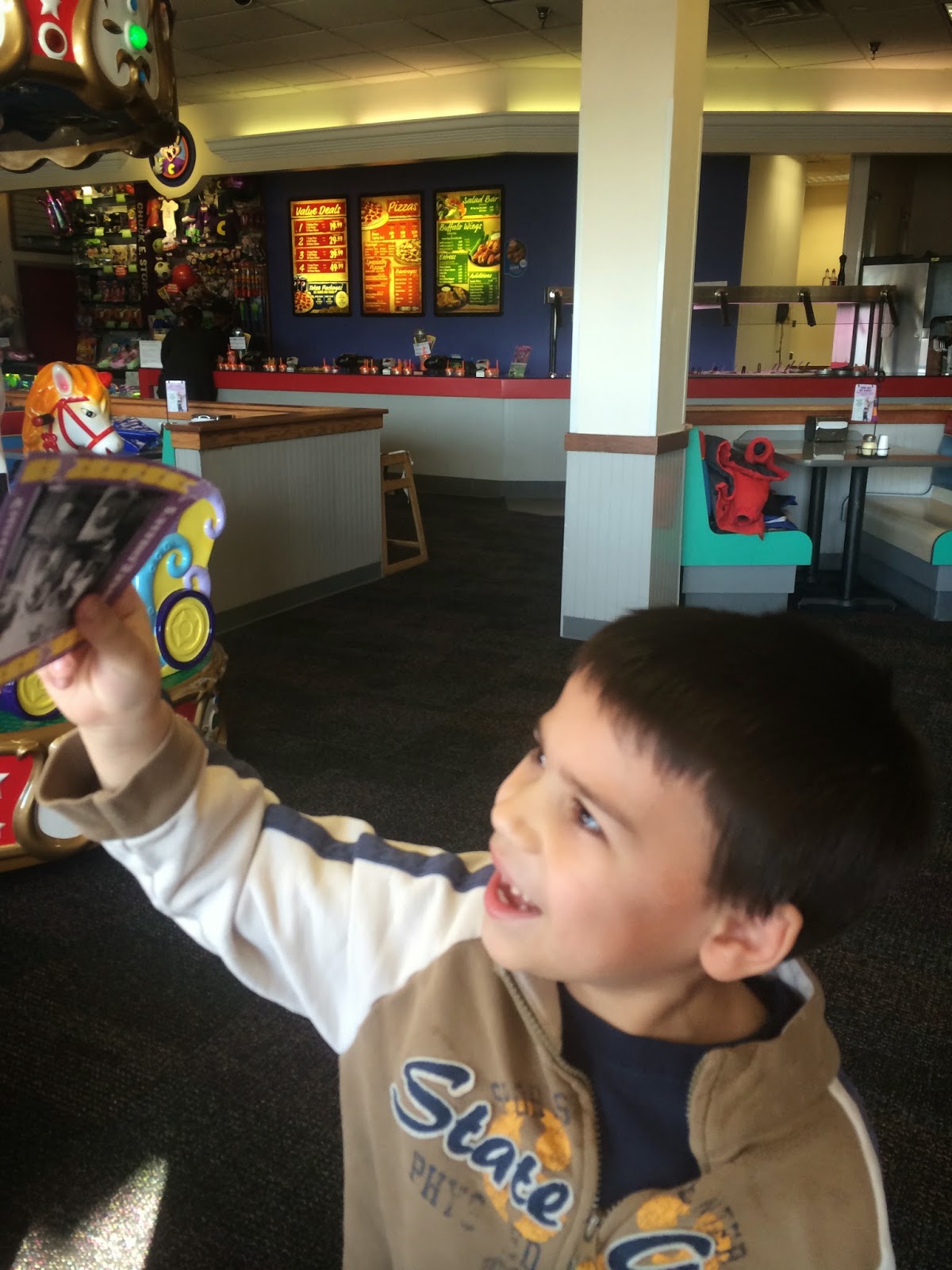
To those that allude to our children being entitled, you couldn't be more wrong. Just as a person who is blind should have access to brail, children who cannot handle the sensory overload that is common to venues like Chuck E Cheese, should have access in a way that is sensitive to their needs.


The attached pictures depict just some of C's moments of pure joy. We have no less than 15 pictures of C riding the Chuck E Cheese Car (picture on the left is of C admiring his picture printed from the ride). He played a racing game that required him to jump on a built in pogo stick in order to make his character move. He used the mallet to "Wack A Mole". C made eye contact with Chuck E Cheese, and introduced himself. He danced to "Head, Shoulders, Knees and Toes" with the other children. He tried his hand at Ski Ball (with assistance). There was no limit to what he was able to try, he was able to take his time, and he chose what he wanted to do, without the pressure of the next kid behind him waiting for a turn.

Again, we couldn't be more grateful for the opportunity, and will certainly participate in future events that this Chuck E Cheese location hosts.


Friday, April 4, 2014

Have a Stimmer?

Self Stimulating Behaviors

What are they, what can I do? 

C is sensory seeking. He loves running his fingers through my hair, the dog's hair, and twirling his own hair is a tell tail sign that he is tired. While no one has directly told us that C has SPD (Sensory Processing Disorder), I think at this point, it is a fair assumption to believe that he does.

Some common characteristics of a child exhibiting SPD:

People suffering from over-responsivity might:
  • Dislike textures in fabrics, foods, grooming products or other materials found in daily living, to which most people would not react. This dislike interferes with normal function, for instance a child who refuses to wear socks or an adult who is so "picky" they can't go to restaurants with friends.
  • Get so car sick they refuse to be in a moving vehicle.
  • Refuse to kiss or hug, not because they don't like the person, but because the sensation of skin contact can be very negative.
  • Feel seriously discomforted, sick or threatened by normal sounds, lights, movements, smells, tastes, or even inner sensations such as heartbeat.
People suffering from under-responsivity might:
  • Fidget excessively
  • Seek or make loud, disturbing noises
  • Suck on or bite clothing, fingers, pencils, etc.
**From Wikipedia


C exhibits mostly over - responsivity symptoms. He frequently will wrap himself around my leg, throw the covers over top of himself, and roll up like a sausage, and is known to squeal when he is happy or excited. 

What we have learned, through Occupational Therapy and Sensory Integration Therapy, is that children will use sensory seeking behaviors to help them better understand their surroundings and how their body fits within those surroundings. It is self soothing, and incorporates one of the fives senses. 
  • Visual  staring at lights, repetitive blinking, moving fingers in front of the eyes, hand-flapping
  • Auditory  tapping ears, snapping fingers, making vocal sounds
  • Tactile  rubbing the skin with one's hands or with another object, scratching
  • Vestibular  rocking front to back, rocking side-to-side
  • Taste  placing body parts or objects in one's mouth, licking objects
  • Smell  smelling objects, sniffing people
 **From the Autism Research Institute

Take, for example, a child who rocks back and forth. Though the behavior is a-typical, it is giving them feedback, allowing them to realize how their body fits within a certain setting. This is considered a "self-stimulating" behavior, or stimming. While it is providing self soothing benefits, research shows that stimming also decreases one's attention to task, correlating with the ability to learn new information. Many professionals in the field advise parents to monitor stimming behaviors and limit them, by giving new behaviors or coping mechanisms to enable the child to attend to a task, and feel comfortable in their environment. 

C has a variety of stims, from tapping his foot, to flapping his hand, he squeals loudly, and will rub his hands over his pants repeatedly. We have tested quite a few strategies to help him cope, specifically in school, but also in the home. We can tell what strategy we need to use, based on the stim. 


For instance, C will run his fingers through my hair. While most times I enjoy it, it also handicaps me from doing anything else. We know that his seeking textile feedback, and have made a rice bin filled with scoops and bowls for him to play with instead. This serves two purposes, it allows me to be a little more free, and allows C to practice fine motor skills, while getting the feedback he is craving. 

C will also, as I stated above, wrap his legs around me, or swaddle himself in blankets. We have a weighted blanket, which provides the pressure (evenly) that he is craving. In school, they have taken this strategy, and have replaced it with a weighted vest, which allows C to walk freely, while still getting the feedback he needs. We have noticed, that when used in school, it helps him attend better to tasks or activities.

We are still working on strategies to use for the squealing. He is high pitched an LOUD! I have heard that chewing gum helps, but I have been hesitant to give it to him, for fear that he may choke. 

We noticed that prior to our understanding of SPD, C was unbalanced, had a toddler gait, could not jump, and did not run with a straight gait. After 2 years of therapies, he is like a new child. He fine motor skills have improved, he is able to jump, and his language even blossomed. 

Many consider OT, or SI (Sensory Integration) for children who lack coordination or fine motor skills, however there are a great many other benefits. We tend to overlook a lot of behaviors that accompany our children, simply because it may be a symptom of the diagnosis. There are strategies to help our children overcome many of the self-stimulating behaviors. While I personally feel that there is a time and place where stimming is appropriate, I also understand that like everything else, it must be done in a structured and strategic manner. 

For more information on Sensory Integration:
Sensory Integration Therapy


Wednesday, November 27, 2013

A Time for Thanks

The holidays are quickly approaching. This is truly my favorite time of the year, and Thanksgiving is by far my most favorite holiday. It is a time when friends and family come together to celebrate each other, to break bread with one another, and is focused on being thankful for all we have. 

Again, I feel compelled to express my sincerest gratitude for all those who have supported Kinera Foundation over the course of the last 6 months. Because of each of you, we have reached more parents and caregivers than I hoped to reach in a year. We have allowed those who service our community an opportunity to speak about their services in a forum that directly reaches those they are trying to help. We have made friends, our children have made friends, and we are on the path to truly fulfilling our mission statement.

THANK YOU!!

With the approaching holidays, comes the stress of preparing our homes and families for the whirlwind of festivities. There are numerous tips and tricks to make this easier on our children who have sensory sensitivities, but below are some tips from a fellow mom, who has attended every meeting and has offered an immense amount of support for Kinera Foundation's future.  

6 Tips to help your child during the busy holiday season


1. Give your child a schedule of events for special activities, particularly on days with lots of transitions. Whether it’s a written schedule or one with pictures for younger kids, your child will feel calmer and safer knowing what is coming up. Discuss the schedule with your child. Sometimes just knowing what’s next can help children with special needs feel less anxiety.
2. Have a code word your child can use if he/she feels overwhelmed and needs a break. Let your child know if he/she uses the code word, you will respond right away. Again, giving children some control during activities that may be overstimulating for them will reduce anxiety and fear of the unknown.
3. Before you leave for holiday parties, parades, or other events, have a quick family meeting so your whole family knows how long you plan to stay and how you expect them to behave. This will benefit neuro-typical children as well, since any child can get overwhelmed with the excitement of the holidays. Continue to make your child’s sleep schedule a priority, even in the midst of so many special events.
4. Children with significant sensory-sensitivities may require a little extra planning to enjoy holiday events. For example, you may need to bring along ear plugs if you will be in a noisy environment or sensory fidgets if the child is expected to sit still. For sensitive kids who need to wear dress clothes for events, bring  along some soft clothes for them to change into as soon as possible. Be prepared by knowing your child’s specific limitations and how you will handle them if the need arises. Don’t wait for the meltdown to begin.
5. If your children have food sensitives or allergies that prevent them from eating holiday treats, plan ahead to offer alternatives like all-natural candy or a gluten-free treat from home. Children with neuro-behavioral disorders like ADHD or autism often already feel different, so be sure to include them in as many holiday festivities as possible.
6. If your child is easily over-stimulated, limit holiday decorations in your home. Too many twinkling lights combined with smells from the kitchen and other holidays distractions, while enjoyable to most, can be too much for children with autism, ADHD, or sensory disorders. Let special needs children help you decorate for the holidays so they are involved in the changes that take place in their comforting environment.

Great article about how Jewish families can celebrate Hanukkah with their children with special needs: http://www.abilitypath.org/areas-of-development/physical-development/sensory/articles/hanukkah1.html
 
A few more tips: http://specialchildren.about.com/od/inthecommunity/a/holiday.htm
 

http://www.friendshipcircle.org/blog/2012/12/12/13-holiday-survival-tips-for-your-child-with-special-needs/

These are great tips for what others can do for a parent of a child with special needs: http://specialchildren.about.com/od/inthecommunity/tp/Things-to-Do-for-a-Parent.htm
 
Gluten Free Holiday Cookie Recipes
http://noshon.it/recipes/13-gluten-free-holiday-cookie-recipes/